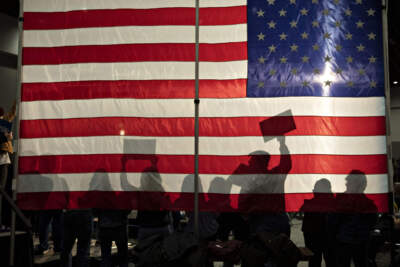
For years, Afghanistan was the “forgotten war,” the forgotten country — even as American soldiers walked its ridges and alleys.
Now, that forgotten country, incredibly, is Iraq.
120,000 U.S. troops are still in Iraq. Combat troops are supposed to be out by next August. But Iraq’s fate and future is still unclear.
Saad Eskander was there in the chaos after the U.S. invasion, as director-general of Iraq’s National Library and Archives. He’s stayed through car bombs, mortar fire, plunder, kidnapping, assassinations and — maybe — rebirth.
This hour, On Point: Iraq now, with Saad Eskander.
You can join the conversation. Tell us what you think — here on this page, on Twitter, and on Facebook.
-Tom Ashbrook
Guest:
Joining us first from Baghdad is Rod Nordland, foreign correspondent for The New York Times.
Saad Eskander joins us in our studio. He is director-general of the Iraq National Library and Archives. A former fighter in the Kurdish resistance movement, he was born in Baghdad and educated in London, where he received his Ph.D. from the London School of Economics. He returned to Iraq in 2003 to take leadership of the devastated National Library.
More links:
Saad Eskander speaks today at the Carr Center for Human Rights Policy at Harvard’s Kennedy School, which has posted this biographical note about him.
In 2006 and 2007, Eskander wrote an online diary for the British National Library on his experiences rebuilding the Library in the midst of Baghdad’s brutal sectarian violence.
The Guardian profiled him earlier this year in a piece titled “Books, tears, and blood.”


What aircraft has the Iraqi Air Force gone with to support air combat, ground combat support and tactical bombing roles?
Posted by Jean Smith, on October 22nd, 2009 at 10:37 am UTCMr. Eskander is a wonderful voice to hear! Our country needs to pay close attention to what this man has to say as we progress in Irag – perhaps the Middle East at large.
Posted by Mark Zamcheck, on October 22nd, 2009 at 10:43 am UTCThanks, Mr. Eskander for the work that you are doing. I hope that the US will return those archives soon and I intend to write to my political representatives about this issue.
Posted by Joanna Drzewieniecki, on October 22nd, 2009 at 10:56 am UTCYou understand, I hope, that many Americans have a hard time understanding the complexity of the situation in Iraq. Anti-war people, despite their good intentions, sometimes have a lack of knowledge about these complexities, the effects of the years of dictatorship and many other things that people probably can only learn by living in countries in the Third World.
Good luck to you,
The caller named Alice nailed it. America has no business defining what’s best for other countries.
Posted by Todd, on October 22nd, 2009 at 11:19 am UTCI love the way Bush haters get antsy when it looks as if he might be vindicated.
Posted by Rachel, on October 22nd, 2009 at 12:48 pm UTC‘Anti-war people, despite their good intentions, sometimes have a lack of knowledge about these complexities…’ -Joanna Drzenwieniecki
One could deduce, aside from your statement being way too much of a broad brush, that you are pro-war, that you think pre-emptively invading other countries is a good idea, that for one country to assert and insinuate itself into the workings of another country is a good idea, etc. I wonder how you’d feel if Scandinavian countries decided the US’s policies on the basic human rights of its citizens were unjust and then attacked us?
I will admit that we helped create a mess in Iraq and should help to clean up that mess. Thinking militarily is not the only solution to problems, however.
Posted by Brett, on October 22nd, 2009 at 2:57 pm UTCRachel , we anti-war people get “antsy’ not because Bush may be vindicated. But because the anti-war voices are seldom if ever heard on “public” radio. I didn’t hear the whole show what I heard sounded like defacto propaganda for a war that was based on a system oof lies perpetrated by the Bush administration. That has never recieved sufficient scrutiny to my knowledge.Finally, why is it an article fo faith in the media that Bush invaded Iraq to establish democracy there? Especially since his lies about WMDs and Saddam’s colaboration with al Qeada have long been discredited.
Posted by Dana Franchitto, on October 22nd, 2009 at 3:30 pm UTCTodd,
You are a mad and diverse fellow. I love it! I agree with your comment (today).
Posted by Cory, on October 22nd, 2009 at 5:25 pm UTCRight on to the Caller Alice and then caller after her. There has been over 2million Iraqi’s displaced in iraq and over 3million outside, i believe the number of iraqi’s killed is around 300k plus.
I don’t quite understand the logic put forth that the iraqi’s see us as hero’s liberators after what we have done. We invaded iraq under the guise of WMD, and stayed under the guise of Spreading democracy, and wanted to stay indifferently if the Bush Admin and our Generals had their way. As Alice noted it’s the corporations that control and run the U.S. not the people. Also to note the countries that helped the U.S. invade got first dips on oil agreements with the iraqi’s backed government
Listed below is the leader of the oil trade union. He talks about the first thing the U.S. did when there got they. It talks about how the U.S. destroy schools, infrastructure, hospitals, His name is Hassan Jumma President of Iraqi Federation of Oil Union.
Also it talks about (PSA) Partnership Sharing Agreement (which btw was illegal in iraq and most if not all heavy oil producing counties).
How about on-point has someone that’s not a u.s. pawn on to get a full view on things.
This is translated and i recommend anyone that wish to learn more listen to this below
http://www.youtube.com/watch?v=YcZx9S-TJn4
Posted by MIchael, on October 22nd, 2009 at 7:56 pm UTCWhile Tom and his guest are trying to figure out why the U.S. took and still has the Iraqi archives, did they ever think of the idea that there might be something incriminating about the U.S. support of Saddam Hussein? Might this be the reason that they won’t restore these records? After all, the U.S. threw its full support behind Saddam during the Iran/Iraq war. Is there something the U.S. doesn’t want the Iraqis to see? signed Marianne
Posted by marlene pollock, on October 22nd, 2009 at 8:06 pm UTCsorry, correction it’s production sharing agreement
Posted by MIchael, on October 22nd, 2009 at 8:11 pm UTCSee what I mean?
Posted by Rachel, on October 23rd, 2009 at 1:04 pm UTCRachel,
Posted by Brett, on October 23rd, 2009 at 1:59 pm UTCFor you to express the belief that the show indicates Bush will be vindicated; and, by extension, the comments reflect ‘Bush haters get[ting] antsy’ is either disingenuous or delusional.
As a Master of Arts candidate interested in issues of national identity, I was fascinated to hear Mr. Eskander speak about the significance of Iraqi archives to the building and maintenance of cultural heritage.
The current situation, with the US holding caseloads of Iraqi archives against the wishes of the Iraqi Government and, I suspect, the Iraqi people, further highlights the weight and symbolism attributed to national documents.
I found myself asking what Mr. Eskander was referring to when he stated that the US was violating international agreements. Something to look into before my presentation on this topic next week.
Gratefully,
Posted by Rebecca Jakob, on October 24th, 2009 at 5:05 pm UTCRebecca